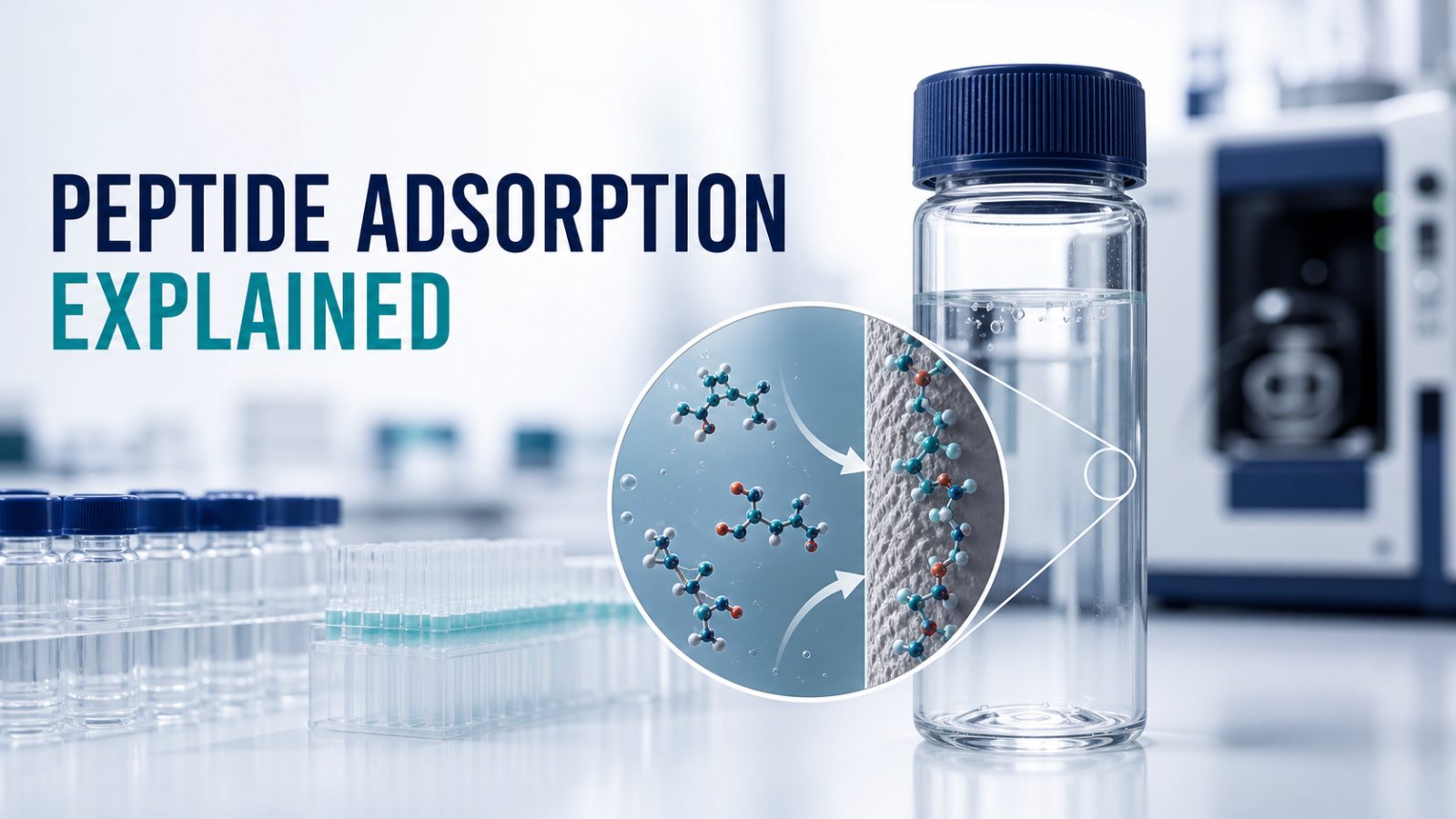
Quick answer: Peptide adsorption is the loss of peptide molecules from a solution because they attach to vials, pipette tips, tubing, filters, instrument components, or other surfaces. The effect can lower measured recovery, distort calibration curves, increase carryover, and create differences between laboratories. It is sequence-, surface-, concentration-, and method-dependent, so no single container material solves every case.
A peptide sample can look perfectly clear and still contain less freely dissolved material than expected. One reason is nonspecific adsorption. Instead of remaining in the liquid phase, part of the peptide population interacts with a solid surface. In an analytical workflow, that surface may be encountered during storage, transfer, dilution, filtration, injection, or chromatography.
This topic receives less attention than purity or degradation, but it can be just as important for reproducibility. When adsorption is not evaluated, a researcher may interpret low signal as low starting concentration, chemical loss, instrument failure, or poor assay sensitivity. The real problem may be that the analyte is sitting on the walls of the system.
What Peptide Adsorption Means
Adsorption occurs at an interface. Peptide molecules approach a material and interact through electrostatic attraction, hydrophobic interactions, hydrogen bonding, van der Waals forces, or a combination of these effects. The attachment may be weak and reversible, or it may persist through later rinse and transfer steps.
Adsorption is different from absorption. Absorption describes material entering the bulk of another phase, while adsorption describes accumulation at a surface. It is also different from chemical degradation: the peptide may remain chemically intact while becoming unavailable to the assay because it is bound to a wall, membrane, tip, or flow path.
Why Some Peptides Stick More Than Others
- Amino-acid sequence. Basic, acidic, aromatic, and nonpolar residues create different interaction patterns with glass, polymers, metals, and coatings.
- Net charge and pH. The charge of both the peptide and the surface can change with pH, altering attraction or repulsion.
- Hydrophobicity. Nonpolar regions may associate with hydrophobic plastics or exposed hydrophobic instrument surfaces.
- Concentration. At low concentration, even a small absolute surface loss can represent a large percentage of the available analyte.
- Contact area and time. Small volumes, repeated transfers, long storage, and large surface-to-volume ratios create more opportunity for loss.
- Formulation components. Buffers, salts, organic modifiers, surfactants, and carrier molecules can change the peptide-surface interaction.
These factors interact. A vial that performs well for one sequence may be unsuitable for another. Even products made from the same broad material class can differ because of manufacturing residues, surface treatment, molding, additives, or coatings.
Where Adsorption Happens
Every transfer introduces a new interface. Common points include storage vials, autosampler vials, multiwell plates, pipette tips, microcentrifuge tubes, syringe filters used in analytical preparation, capillaries, chromatography tubing, injection valves, and column materials. A workflow may therefore accumulate small losses across many steps rather than suffer one obvious failure.
Glass is not automatically neutral. Residual silanol groups can participate in electrostatic interactions, particularly with basic peptides. Polypropylene is not universally low-binding either; hydrophobic sequences may interact with its nonpolar surface. Specialized low-retention or low-protein-binding products can reduce losses in some settings, but their performance should be tested with the actual peptide, concentration, solvent, and contact time.
How Adsorption Distorts Results
- Lower recovery. Measured concentration falls below the amount prepared because part of the peptide is no longer in the sampled liquid.
- Nonlinear calibration. Losses may be proportionally larger at the low end of a dilution series, bending a curve that should be linear.
- Poor precision. Small differences in timing, mixing, transfer count, or container lot can produce large differences between replicates.
- Carryover. Material retained in an autosampler, injection path, or chromatography system may appear in a later blank or sample.
- Biased stability conclusions. A falling signal can be mistaken for chemical degradation when the dominant mechanism is surface loss.
How Laboratories Evaluate Surface Loss
A useful experiment isolates the surface variable while holding the peptide, concentration, solvent, temperature, and time constant. Researchers may compare recovery after incubation in different vial types, measure a solution before and after sequential transfers, or test multiple surface-to-volume ratios. Replicate measurements and appropriate blanks help separate true adsorption from instrument drift or preparation error.
Carryover is often checked by running a blank immediately after a peptide-containing sample. A detectable response in the blank can indicate retained material somewhere in the injection or separation path. That observation does not identify the exact location by itself, so a structured rinse study or component-by-component investigation may be needed.
Recovery experiments should also consider time. Fast adsorption may occur during the first contact, while slower rearrangement on a surface may continue over hours. Reporting only the container name without contact duration, fill volume, and solution composition makes the result difficult to reproduce.
Reducing Adsorption in an Analytical Workflow
There is no universal recipe, but laboratories can reduce uncertainty through method development. The first step is minimizing unnecessary transfers and choosing vessels with an appropriate surface-to-volume ratio. Container materials and low-binding treatments should then be compared experimentally rather than selected from marketing language alone.
- Qualify the container. Test the actual vial or plate with the intended sequence, concentration, matrix, and holding time.
- Control transfers. Use a consistent number of transfers and document whether tips are preconditioned in validated analytical procedures.
- Evaluate formulation effects. Determine whether a buffer, salt, surfactant, carrier, or solvent modifier improves recovery without interfering with the assay.
- Monitor blanks. Use blank injections or wash studies to identify retained material and carryover.
- Record material details. Document manufacturer, product number, lot, surface treatment, and storage history instead of writing only “plastic vial.”
Any mitigation must be compatible with the analytical purpose. An additive that reduces adsorption may change ionization, chromatographic retention, detector response, or downstream sample handling. Method performance should therefore be evaluated as a complete system.
What Good Documentation Should Show
A strong analytical record identifies the exact peptide lot, nominal and measured concentration, matrix, container, contact time, temperature, transfer count, and analytical method. It should distinguish adsorption from chemical degradation and state how recovery was calculated. If a low-binding container or formulation additive is part of the method, its identity and concentration should be documented as well.
For product comparisons, a certificate of analysis does not usually answer every adsorption question. Identity and chemical purity results describe important attributes, but surface recovery is often method-specific. Readers should be cautious when a general quality statement is presented as proof that every storage or analytical setup will behave the same way.
The Bottom Line
Peptide adsorption is an easy-to-miss source of analytical error. Molecules can attach to common laboratory materials without creating a visible change, reducing recovery and complicating interpretation. The risk is highest when concentrations are low, surface area is large, transfers are numerous, or the sequence strongly interacts with the chosen material.
The most reliable response is not a blanket rule about glass or plastic. It is a controlled recovery study using the actual peptide, matrix, container, concentration, and workflow. That approach turns a hidden surface effect into a measurable method variable.
Editorial note: Educational laboratory-research content only. No medical advice, dosing guidance, preparation instructions, or directions for human use.