
Waiting on a permit is one of the least productive parts of running an oversize haul, and yet most of the delay carriers experience is avoidable once the common bottlenecks are understood. The states that process these applications aren’t trying to slow anyone down — they’re working through the same handful of issues over and over, and the carriers who consistently get fast approvals are usually the ones who’ve learned to eliminate those issues before they ever reach a reviewer’s desk.
Submit Complete, Accurate Dimensions the First Time
The single biggest speed factor is also the simplest to control: getting the numbers right on the first submission. Missing measurements, rough estimates instead of exact figures, or a mismatch between the application and the load’s actual dimensions almost guarantees a manual review, and manual reviews are where processing time disappears. States move fastest through applications that give them nothing to question — full axle spacing, accurate overhang measurements front and rear, and dimensions that reflect the trailer itself rather than just the cargo sitting on it. Carriers who treat this step casually, assuming small discrepancies won’t matter, are usually the ones surprised when a routine permit takes twice as long as expected.
Check Route Restrictions Before Applying, Not After a Rejection
A route that runs into a restricted bridge or a low-clearance structure gets flagged during review regardless of how clean the rest of the application looks, and fixing that after submission means restarting part of the process rather than adjusting a single field. Carriers who verify restricted structures ahead of time — cross-referencing the proposed route against each state’s bridge and clearance data before filing — routinely avoid the slowest category of delay entirely. This matters even more on multi-state hauls, where a single overlooked structure in one state can force a redraw affecting the entire route, not just the segment where the problem was found.
Get the Permit Type Right From the Start
Picking the wrong category costs more time than most carriers expect, and it’s usually avoidable. A load that’s actually a superload but goes in as standard oversize doesn’t just get flagged — it gets bounced back entirely, and the whole thing has to restart under the correct classification, which in practice means the wait starts over from zero. The tricky part is that the line between the two isn’t fixed: a load that counts as standard oversize in one state can tip into superload territory in the next, purely based on where that state sets its threshold. So it’s worth checking that specific number for that specific state before filing, rather than assuming the classification that worked last time still applies. It adds a few extra minutes upfront, but that’s nothing compared to finding out after a rejection that the whole application needs to be redone.
Match Escort Requirements to the Load Before Filing
Applications submitted without the correct escort designation, or with escort details that don’t line up with the load’s actual size, typically get sent back for correction instead of moving forward as-is. Confirming the exact thresholds that trigger an escort requirement in each state on the route — and whether that means front, rear, or both — before submission removes one of the more common reasons applications bounce back. This is especially worth double-checking on routes crossing multiple states, since the same load can need a single escort in one state and two in the next.
Apply With Enough Lead Time to Absorb the Unexpected
Even a flawless application takes time to process, and processing speed varies significantly by state, season, and current application volume. Submitting close to the intended travel date leaves no room to absorb a state holiday, a weather-related restriction, or simply a busier-than-usual queue at the permitting agency. Building in extra lead time doesn’t just protect against delays — it gives a carrier room to correct an issue quickly if one does come up, rather than scrambling against a deadline that’s already tight.
Work With Someone Who Tracks the Variables Across States
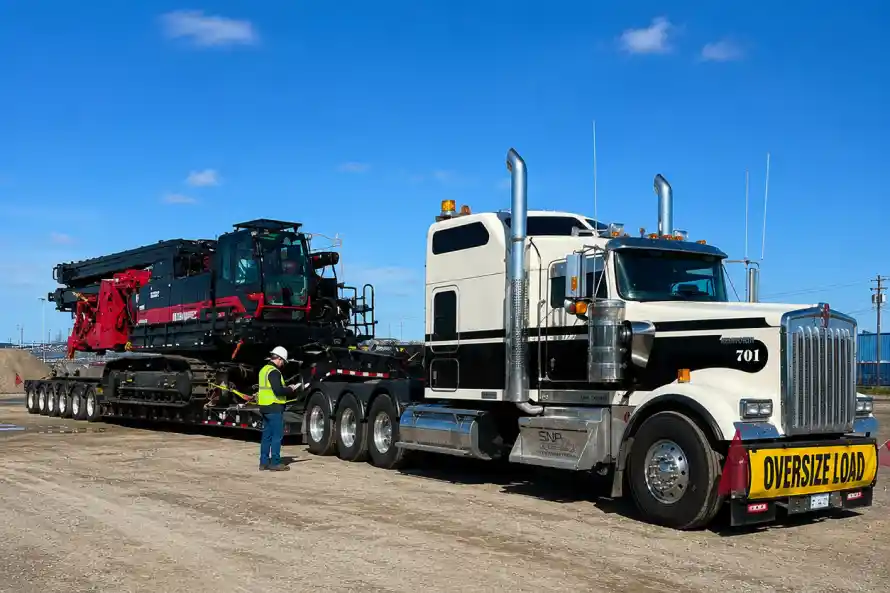 Because permit requirements, fee structures, and processing timelines differ so much from state to state, carriers running frequent multi-state routes often find it faster to work with a service that already tracks those variables rather than researching them fresh for every haul. Omnistar keeps up with the state-specific requirements that most commonly cause delays, which means fewer applications get flagged for the avoidable reasons outlined above. For carriers who don’t move oversize loads often enough to justify tracking fifty different sets of rules internally, that kind of ongoing familiarity with oversize truck permits tends to save more time than any single fix applied after the fact.
Most of what slows down an oversize permit comes down to the same short list — incomplete data, unchecked routes, mismatched escort details, or simply applying too late. Carriers who address these before submission, rather than reacting to them after a rejection, consistently see faster turnaround than those treating the permit process as a formality to handle at the last minute.