Sea moss has gone from a niche ingredient to a mainstream wellness staple, and that surge in popularity has created a new problem: not all sea moss on the market is grown or harvested the same way.
If you’ve ever compared two bags of dried sea moss and wondered why one looked sun-bleached, wiry, and uneven while the other appeared bright, uniform, and almost too clean, you were probably looking at two very different production methods. The most common distinction is between wildcrafted sea moss and pool-grown sea moss. That difference matters, not just for appearance, but for texture, mineral profile, and overall quality.
The tricky part is that labels don’t always tell the full story. “Wild,” “natural,” and “premium” are used loosely, and shoppers are often left trying to decode marketing language instead of getting straight answers. Knowing what to look for can help you make a far more informed choice.
What Wildcrafted and Pool-Grown Actually Mean
Before you can judge quality, it helps to understand the terms.
Wildcrafted sea moss
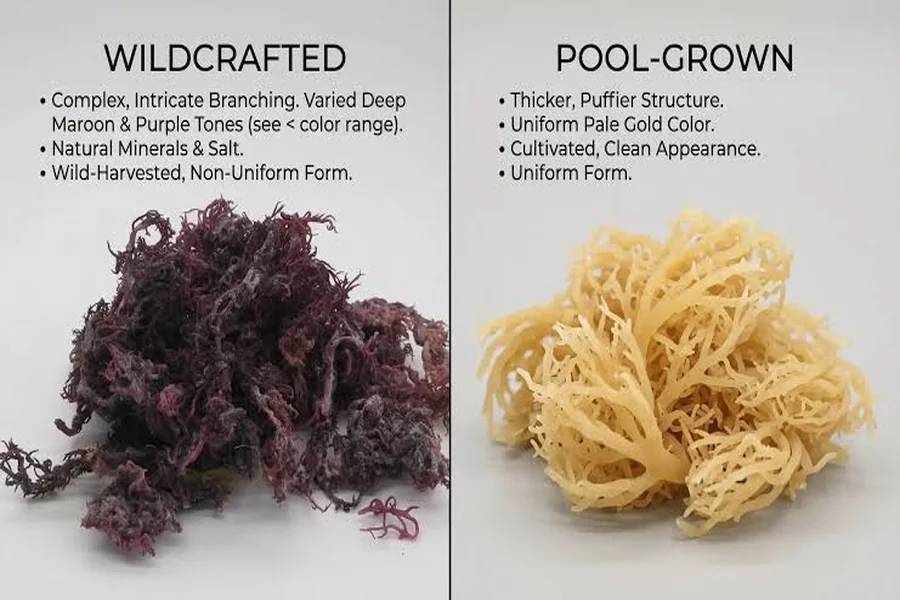
Wildcrafted sea moss is harvested from its natural marine environment, typically growing on rocks in the ocean. It develops under changing conditions: waves, currents, salinity shifts, sunlight exposure, and interactions with surrounding marine life. Because of that, its appearance tends to be irregular. One batch may have thick strands, another finer fronds. Colors can range from golden and purple to deep brown or greenish tones depending on the variety and where it was collected.
In other words, variation is usually part of the package.
Pool-grown sea moss
Pool-grown sea moss, sometimes called farmed sea moss, is cultivated in man-made saltwater pools or controlled tanks. This method makes production more predictable and scalable. Growers can manage water conditions, reduce loss from storms, and produce a more visually consistent crop.
That consistency, however, is exactly why many people find it harder to evaluate. Uniformity can look appealing, but it doesn’t automatically mean better quality. A product that looks polished may simply be the result of a more controlled growing process.
The Most Noticeable Differences Are Visual
For most buyers, appearance is the first clue.
Wildcrafted sea moss typically looks less “perfect.” Expect uneven strand sizes, tangled clusters, traces of natural salt residue, and color variation throughout the batch. It may also carry a stronger ocean smell, especially before rinsing. That briny scent isn’t necessarily a flaw; often, it’s a sign that the sea moss hasn’t been excessively processed.
Pool-grown sea moss usually looks cleaner and more standardized. Strands may be lighter in color and more uniform in length and shape. Sometimes it appears almost translucent or overly neat. That doesn’t make it unusable, but it does tell you something about how it was produced.
If you’re trying to judge a product based on photos alone, a helpful starting point is this natural vs farmed sea moss quality comparison, which breaks down some of the differences buyers commonly overlook.
Why color can be misleading
One common mistake is assuming that brighter sea moss is automatically fresher or more potent. In reality, sea moss can be lightened through washing, sun exposure, or bleaching practices. Naturally harvested sea moss often darkens in the ocean and lightens somewhat when dried, but extreme uniform brightness can be a cue to ask more questions.
Color should be read alongside texture, smell, and sourcing information, not on its own.
Texture, Smell, and Rehydration Tell You a Lot
Once you have the product in hand, the next test is sensory.
Texture
Wildcrafted sea moss often feels firmer and more wiry when dry. After soaking, it tends to expand irregularly and develop a more natural, slightly coarse structure before blending into gel.
Pool-grown sea moss may feel softer or thinner right out of the bag. Once soaked, it can become slippery quickly and may look more delicate. That isn’t always negative, but experienced buyers often notice the difference.
Smell
A mild ocean scent is normal, especially with wildcrafted sea moss. If it smells strongly chemical, overly neutral, or oddly perfumed, something may be off. Sea moss should smell like the sea, not like it’s been deodorized.
Rehydration
How sea moss behaves in water can be revealing. Wildcrafted varieties usually swell unevenly, because the strands themselves aren’t uniform. Pool-grown sea moss often hydrates more consistently. Again, consistency is not proof of inferiority, but it does reflect a different growth environment.
Ask Where It Came From, Not Just What It’s Called
This is where many labels fall apart.
A seller can call sea moss “wildcrafted” without explaining where it was harvested, how it was dried, or whether it was cleaned with minimal handling. Credible sourcing should include the harvest region and, ideally, some transparency around post-harvest processing.
Here are a few practical questions worth asking before you buy:
- Was it harvested from the ocean or cultivated in man-made pools?
- What region did it come from?
- Was it sun-dried or machine-dried?
- Has it been bleached, dyed, or heavily cleaned?
- Do batch photos show natural variation?
If a brand can’t answer basic sourcing questions, that’s a warning sign. Good suppliers usually want to explain their process because transparency is part of quality.
Why the Difference Matters Beyond Looks
The debate around wildcrafted versus pool-grown sea moss often turns into a purity argument, but the more useful question is simpler: what kind of product are you actually getting?
Wild marine growth exposes sea moss to a broader natural ecosystem, which many consumers associate with a more robust mineral profile and a less manipulated end product. Pool-grown sea moss offers scalability and easier standardization, which can be helpful for commercial supply chains but may produce a product that feels more engineered than naturally formed.
Neither category should be judged by marketing alone. The better approach is to look at the total picture: source, handling, appearance, smell, and behavior after soaking.
Quality is usually about clues, not one perfect test
There’s no single shortcut that tells you everything. A dark color doesn’t guarantee wildcrafted origin. A clean appearance doesn’t automatically mean poor quality. But when several clues line up, the difference becomes easier to spot.
A genuinely high-quality sea moss product tends to come with:
Credible signs of authenticity
Clear sourcing details, visible natural variation, a fresh marine smell, and minimal signs of over-processing are all encouraging indicators. When those are missing, it’s worth being skeptical.
A More Informed Buyer Makes Better Choices
Sea moss is a simple ingredient, but shopping for it isn’t always simple. The rise of pool-grown products has made sea moss more available, while also making labels harder to interpret. That means buyers need to rely less on buzzwords and more on observation.
If you remember just one thing, let it be this: natural products rarely look perfectly identical. Wildcrafted sea moss usually carries the marks of where it came from, and those imperfections are often the very clues that help distinguish it from pool-grown alternatives.
The more familiar you become with those cues, the easier it is to separate authentic quality from polished presentation.