The stadium lights in the U.S. Open usually illuminate tactical footwork and blistering serves, but during the opening rounds, the initial focus shifted entirely to a wardrobe choice. When Naomi Osaka stepped onto the hard court, the traditional athletic warmup jacket was replaced by a giant, tiered green bow attached to a custom avant-garde jacket. Beneath it, she wore a matching tennis dress featuring layers of tulle that billowed with every lateral movement. Sports commentators scrambled to analyze the aerodynamic impact of the skirt, while fashion editors immediately logged the look as a landmark moment in contemporary style. This intersection created a distinct cultural collision, transforming a standard sports broadcast into a premier runway reveal.
This moment established a new precedent for modern sports celebrities. Historically, athletes treated fashion as an off-season hobby or a post-career retirement plan, keeping their competitive uniforms strictly utilitarian. Osaka dissolved these boundaries by bringing high-fashion conceptualism directly into the competitive arena. The green bow was not an afterthought or a promotional obligation; it operated as an integral part of her competitive presentation. By merging subculture aesthetics with elite athletics, she challenged the notion that top-tier athletes must present a singular, hyper-focused image to be taken seriously.
The immediate media reaction proved that the public no longer views sports and style as separate entities. Social media feeds split evenly between match statistics and outfit close-ups, with both topics generating equal analytical weight. This duality defines Osaka’s current cultural footprint. She operates in a space where a forehand winner and a design choice command identical levels of global scrutiny. The walk-on sequence demonstrated that her brand relies on total creative control, proving that athletic brilliance does not require the suppression of personal style.
This synthesis alters how the public consumes tennis matches. Audiences tune in not just to witness numerical victories, but to observe an unfolding visual narrative. The court functions simultaneously as a high-stakes athletic battlefield and a premier global launchpad for boundary-pushing design. Osaka enters the stadium with the understanding that her attire carries as much narrative weight as her performance, positioning herself as the architect of a new archetype where athletic dominance and high-fashion expression exist as a unified force.
The Anatomy of the Dual Identity
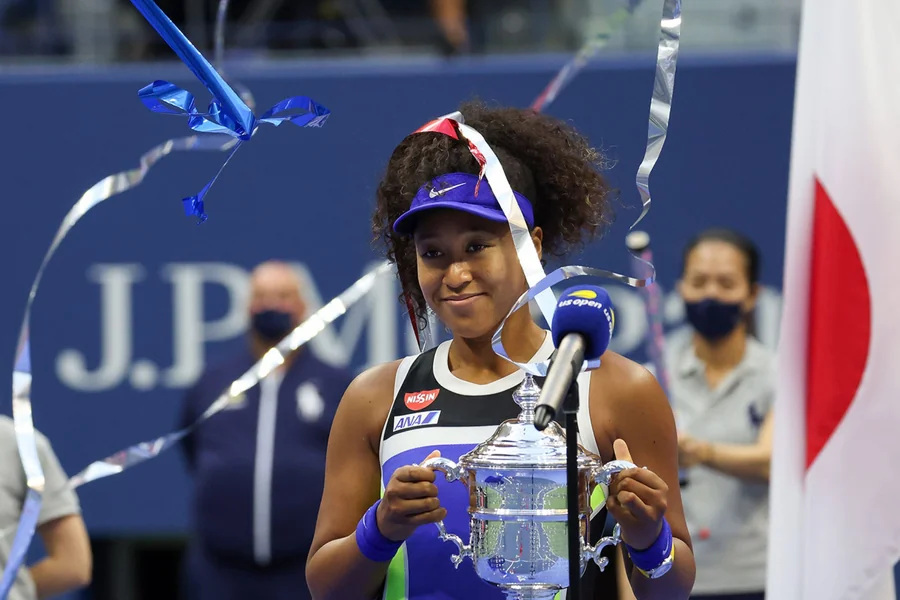
Evaluating Osaka requires an analysis of her competitive resume, which places her among the elite tier of modern tennis. She holds four Grand Slam singles titles, secured through consecutive victories at the U.S. Open in 2018 and 2020, and the Australian Open in 2019 and 2021. Her baseline play, characterized by a dominant serve and relentless groundstrokes, propelled her to the World No. 1 ranking, making her the first Asian player to hold the top spot in singles tennis. These achievements provide the foundation for her global platform. Without these championship credentials, her stylistic choices would lack the disruptive power they carry; her athletic authority grants her the leverage to alter court traditions.
Simultaneously, Osaka occupies a prominent position within the fashion industry that extends far beyond standard endorsement deals. Luxury houses like Louis Vuitton selected her as a global brand ambassador, anchoring her image in high-end retail. She served as a co-chair for the Met Gala, an honor typically reserved for film icons, design moguls, and legacy editors. Her design contributions include collaborative capsule collections with brands like Nike and Yoon Ahn, where she actively participates in fabric selection, silhouette development, and thematic framing. These credentials establish her as a legitimate industry creator rather than a passive model.
A compelling paradox exists between her introverted public persona and her loud sartorial choices. In press rooms, Osaka speaks softly, frequently using deliberate pauses and downplaying her personal achievements. On the court, however, her wardrobe choices demand immediate attention through vibrant neon palettes, oversized bows, and complex asymmetrical patterns. This contrast suggests that fashion serves as a deliberate visual language for an athlete who prefers to avoid verbal bombast. Her garments communicate a distinct sense of confidence and defiance that complements her quiet off-court demeanor.
This dual identity creates a symbiotic relationship where each discipline reinforces the other. Her tennis victories grant her the cultural capital required to command the attention of elite designers, while her high-fashion alignment elevates her visibility beyond traditional sports networks. She reaches audiences who do not follow tournament brackets but closely monitor runway trends. By maintaining a presence in both sectors, she avoids the limitations faced by single-dimension public figures. Her identity relies on this balance, demonstrating that peak athletic performance can coexist with intense creative exploration.
The Racquet and the Runway: A Direct Visual Comparison
The trajectory of Osaka’s career reveals a clear correlation between her competitive milestones and her visual evolution. During her breakthrough at the 2018 U.S. Open, her appearance matched the standard template of a rising tour player. Dressed in utilitarian, mass-produced corporate sportswear, her clothing reflected the traditional constraints placed on unproven athletes. Her focus remained entirely on survival within the draw, and her wardrobe mirrored that singularity of purpose. As she secured her first major title against Serena Williams, her clothing was simple, serving as a neutral backdrop to an historic athletic arrival.
Once her championship status was secure, her aesthetic choices expanded to reflect her multicultural heritage. As a Japanese-Haitian-American athlete, she began utilizing her wardrobe to explore complex narratives of identity. At Wimbledon, where strict all-white dress codes historically suppressed individual expression, she introduced subtle, custom structural elements, including a white kimono-inspired wrap garment during her arrivals. This design paid direct homage to traditional Japanese attire while operating within the rigid boundaries of the All England Club, proving that heritage could be integrated into the most conservative spaces in sports.
Her return to competitive tennis after maternity leave marked a shift toward avant-garde, armor-like silhouettes. The 2024 court designs featured structured, tiered layers and oversized bows that altered her physical silhouette on court. These garments functioned as visual statements of resilience, symbolizing a deliberate reclaiming of her space in elite sports. The clothing no longer merely accommodated athletic movement; it actively projected a narrative of motherhood, return, and artistic independence, shifting her public image from a young prodigy to a mature cultural director.
Redefining the “Power Suit” (The Court as a Political Canvas)
Osaka transformed the concept of athletic apparel by converting her sportswear into a vehicle for political commentary and social advocacy. During the 2020 U.S. Open, held amidst global protests against racial injustice, she entered the stadium for each round wearing a black face mask bearing the name of a Black victim of police brutality. She brought seven masks to the tournament, matching the exact number of rounds required to win the title. This deliberate planning tied her competitive survival directly to her advocacy, ensuring that each victory forced the public to confront structural racism. The masks functioned as a somber extension of her uniform, blending utility with political urgency.
This strategy challenged the long-standing traditions of tennis governing bodies, which historically penalized political expression in favor of absolute neutrality. For decades, the sport enforced rules designed to keep the focus entirely on the game, often suppressing athlete activism. Osaka bypassed these restrictions by utilizing essential health equipment as her primary communicative tool. By doing so, she forced corporate sponsors and tournament directors to accept social commentary as a permanent element of the match-day presentation, shifting the boundaries of what is permitted on a professional court.
The visual impact of these choices extended far beyond the sports pages, appearing on restaurant tables where fans scanned sports sections, on news broadcasts, and across political forums globally. By utilizing a highly visible canvas, she demonstrated that an athlete’s uniform could spark international dialogue. This approach shifted the definition of the corporate “power suit” from a symbol of corporate conformity to a tool of public resistance. The choice proved that fashion on the court can carry profound moral weight, operating as an open ledger of societal critique rather than a mere commercial billboard.
Furthermore, her aesthetic choices during periods of intense mental health advocacy highlighted the connection between wardrobe and personal autonomy. When she withdrew from the French Open to protect her mental well-being, her subsequent returns featured highly customized garments that felt protective, utilizing high collars, layered fabrics, and expressive colors. These choices served as a visual boundary, signaling that her body and her image belonged to her, not to the tournament organizers or the media corps. Through these garments, she established that self-care and artistic expression are deeply intertwined, forever changing the expectations placed on public figures under pressure.
The Commercial Blueprint of the Modern Icon
The financial structure supporting Osaka moves away from traditional, performance-based athletic income toward a diversified corporate ecosystem. While tournament prize money remains a metric of competitive success, it represents a fraction of her total valuation. Osaka has built an independent enterprise, Naomi Osaka Inc., which prioritizes equity ownership over simple endorsement fees. By securing stakes in the brands she represents, she insulates her financial future from the inherent risks of professional sports, such as sudden injuries or natural dips in performance rankings.
A key component of this business strategy is her production company, Hana Kuma, formed in partnership with SpringHill Company. Hana Kuma focuses on developing culturally specific stories, documentaries, and scripted content that highlight diverse perspectives. This move into media production allows Osaka to transition from being the subject of sports journalism to the executive controller of her own media narratives. The company operates independently of her tennis schedule, generating content that appeals to global audiences interested in broader cultural themes rather than specific match statistics.
Her entrepreneurial portfolio also includes the launch of Kinlò, a functional skincare brand formulated specifically for people with melanated skin. The brand addresses a specific medical and cosmetic gap in the market, focusing on sun protection education for underserved demographics. Rather than merely licensing her name to an existing cosmetics giant, Osaka took on the role of chief executive, managing product development, public health messaging, and retail distribution. This venture demonstrates her ability to identify commercial needs and deploy her personal brand to solve real-world problems.
This structural diversification fundamentally changes the leverage dynamic between athletes and corporate sponsors. Traditional sports contracts often bind players to strict behavioral clauses and rigid promotional schedules, limiting their independence. Osaka’s emphasis on equity and original business creation allows her to set her own terms, turning corporate relationships into peer-to-peer partnerships. Her commercial footprint provides a blueprint for the modern multi-hyphenate athlete, showing how to leverage early sports success into a self-sustaining corporate entity that commands influence across multiple global industries.
The New Archetype: The Erasure of the Career Boundary
Attempting to categorize Osaka as exclusively a tennis player or a fashion celebrity applies an outdated twentieth-century framework to a contemporary cultural phenomenon. The modern media environment no longer requires individuals to restrict their activities to a single professional vertical. Osaka’s career demonstrates that excellence in elite sports and prominence in high fashion are not mutually exclusive pursuits; they are integrated components of a comprehensive public identity. She has rendered the traditional boundary between the stadium and the runway completely obsolete.
Her legacy rests on her refusal to accept the limitations historically placed on female athletes. For generations, sports culture demanded that competitors maintain an absolute, monomaniacal focus on their game, viewing external interests as costly distractions. Magazines and news outlets frequently debated whether a player’s off-court activities were harming their competitive consistency. Osaka dismantled this narrative by winning grand slams while simultaneously launching brands, attending fashion weeks, and directing design houses. She proved that creative exploration can fuel athletic drive rather than diminish it.
Her influence is visible in the changing behavior of the next generation of athletes, who now enter professional tours with explicit creative ambitions. The current crop of players routinely signs with modeling agencies, curates distinct on-court aesthetics, and demands creative input from their sponsors before hitting their first ball. The expectation that an athlete must wait until retirement to explore artistic passions has disappeared. Osaka served as the primary disruptor of this old system, opening the door for competitors to exist as full cultural entities from the very start of their careers.
Ultimately, Osaka represents the definitive shift away from the era of the single-focus athlete. She occupies the pinnacle of sports performance and the heights of global style simultaneously, navigating both arenas entirely on her own terms. Her presence in fashion magazines does not dilute her threat on a tennis court, and her grueling practice schedule does not diminish her relevance to elite designers. By embracing both worlds without compromise, she has rewritten the rules of modern celebrity, establishing a permanent precedent for what a global icon can achieve.