
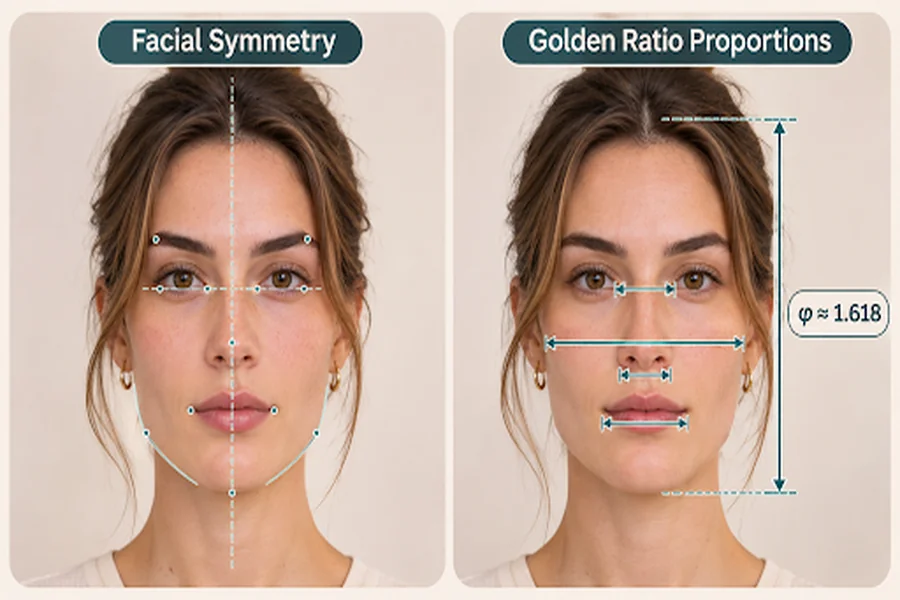
The golden ratio face concept suggests that mathematical proportions can help describe facial balance. Artists and researchers have explored these relationships for centuries, and modern AI tools make it possible to examine facial measurements using photographs.
But does having facial proportions close to the golden ratio mean someone is more attractive? Not necessarily. Facial proportions can be measured, but beauty involves much more than mathematics.
Understanding your facial proportions can also help you choose hairstyles that complement your features. This guide explains golden ratio analysis, facial symmetry, and how to apply these insights to practical hairstyling decisions.
What Is a Golden Ratio Face?
The golden ratio is approximately 1.618, represented by the Greek letter phi (φ). It describes a mathematical relationship in which the ratio of a whole to its larger part equals the ratio of the larger part to the smaller part.
In facial aesthetics, this concept is sometimes applied to measurements such as:
- Overall face length relative to width
- Mouth width compared with nose width
- Eye spacing relative to facial width
- Distances between the eyes, nose, lips, and chin
A face described as approaching golden ratio proportions has selected measurements close to this mathematical relationship.
The concept has historical connections to art and design. Luca Pacioli discussed mathematical proportions in his 1509 work De Divina Proportione, illustrated by Leonardo da Vinci.
However, the golden ratio is not a scientifically established universal standard of beauty.
Golden Ratio vs. Facial Symmetry: What’s the Difference?
Golden ratio proportions and facial symmetry describe different characteristics.
Facial Symmetry
Facial symmetry describes how closely the left and right sides of the face correspond.
It may involve comparing eye positioning, eyebrow height, cheek contours, and jawline alignment.
Perfect symmetry is uncommon. Minor differences between facial features are natural.
Golden Ratio Proportions
Golden ratio analysis examines mathematical relationships between facial measurements rather than whether both sides match.
A face can be relatively symmetrical without matching golden ratio proportions. Someone may also have proportions close to a mathematical benchmark while displaying natural asymmetry.
Research by Pallett, Link, and Lee (2010) explored preferred facial proportions, but its findings do not establish that the golden ratio determines beauty.
How to Analyze Your Golden Ratio Face With AI
AI-powered facial analysis makes exploring facial proportions easier without requiring manual measurements.
For readers interested in mathematical facial relationships, Facefy’s golden ratio face analysis tool provides a convenient starting point for examining visible facial proportions.
The tool is particularly relevant when exploring how facial measurements relate to your overall appearance before choosing hairstyles or other styling options.
Facefy also provides a Facefy Golden Ratio Face Analyzer for exploring these mathematical relationships.
Step 1: Choose a Clear Photograph
Select a front-facing photograph with your head upright and facial features visible.
Use even lighting and avoid filters that modify facial contours.
Step 2: Analyze Facial Features
Computer vision systems identify visible reference points around the eyes, nose, mouth, and chin.
These landmarks help estimate distances and relationships between features.
Step 3: Examine Facial Proportions
Selected measurements can be compared with proportional benchmarks, including the golden ratio.
These comparisons describe geometry rather than establishing an objective attractiveness ranking.
Step 4: Interpret Your Results
Consider which measurements the analysis highlights and how they relate to your facial structure.
Camera angles, expressions, lighting, and lens distortion can influence results, so treat measurements as estimates.
Which Facial Features Are Used in Golden Ratio Analysis?
Facial proportion analysis examines several relationships that can also influence hairstyle choices.
Vertical Facial Proportions: The Rule of Thirds
The traditional rule of thirds divides the face into three approximate sections:
- Hairline to eyebrows
- Eyebrows to the base of the nose
- Base of the nose to the chin
These sections provide a framework for understanding vertical facial balance.
Equal thirds are a classical aesthetic reference, not a requirement for attractiveness.
Horizontal Facial Proportions: The Rule of Fifths
The rule of fifths divides facial width into five approximate vertical sections.
In the classical model, each section is roughly equivalent to one eye width.
This framework describes eye spacing and facial width, although natural proportions vary considerably.
Face Length and Width
One commonly discussed measurement compares overall facial height with width.
A ratio near 1.618 is sometimes presented as an aesthetic benchmark, but research does not establish it as ideal for everyone.
Eyes, Nose, and Mouth
Additional measurements may include eye spacing, nose width, mouth width, and distances between facial features.
No individual measurement determines someone’s attractiveness.
How to Choose Hairstyles Using Facial Proportions
Golden ratio analysis can provide information about facial proportions, but hairstyle selection should focus on creating the visual effect you prefer.
Hairstyles for Longer Faces
If your face appears noticeably longer than it is wide, consider hairstyles that introduce fullness around the sides.
Curtain bangs, shoulder-length waves, and layered cuts can create the impression of additional width.
Hairstyles for Rounder Faces
For faces with similar length and width, crown volume and longer layers can create a more elongated appearance.
Long bobs and side parts are additional options worth exploring.
Hairstyles for Angular Jawlines
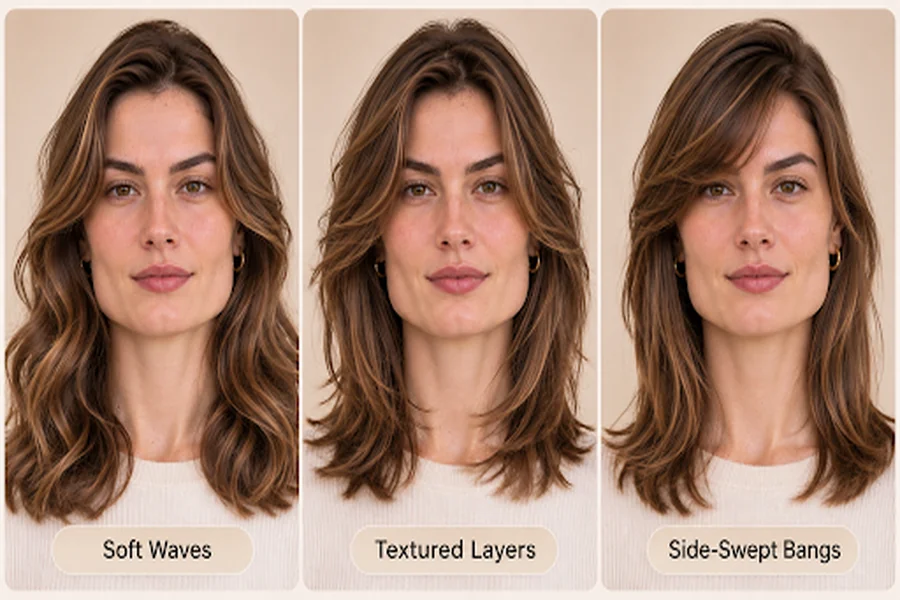
Square or angular facial contours can be complemented by soft waves, textured layers, and side-swept bangs.
These styles introduce movement around the jawline without requiring changes to natural facial structure.
Hairstyles for Wider Foreheads or Prominent Cheekbones
Heart-shaped faces may benefit from chin-length bobs or layers that add fullness around the lower face.
For diamond-shaped faces, hairstyles with volume around the temples can complement prominent cheekbones.
These suggestions are styling possibilities rather than strict rules.
Exploring Face Shape Alongside Facial Proportions
Golden ratio measurements describe relationships between features, while face shape analysis focuses on overall facial contours.
Common categories include oval, round, square, heart, diamond, and oblong.
Many people have characteristics associated with multiple categories, making classifications approximate.
For a more practical approach to choosing hairstyles, Facefy offers AI-powered facial analysis tools that help users explore their natural features and styling possibilities.
Its Face Shape Detector can help identify facial outlines and provide a useful starting point for hairstyle decisions.
Hair texture, density, maintenance requirements, and personal preferences should remain important considerations.

How to Get More Consistent Facial Analysis Results
Photograph quality influences AI-based measurements.
For better consistency:
- Use soft, even lighting.
- Keep the camera at eye level.
- Avoid close-up wide-angle distortion.
- Maintain a relaxed expression.
- Move hair away from your forehead and jawline.
When comparing photographs, keep lighting, camera distance, and head positioning similar.
Differences between results may reflect photographic conditions rather than actual facial changes.
Can the Golden Ratio Determine Facial Attractiveness?
The golden ratio can describe mathematical relationships, but it cannot objectively determine beauty.
Attractiveness judgments involve facial features, expressions, cultural influences, and personal preferences.
Why Facial Harmony Is More Than One Number
Facial harmony describes how features appear together.
Someone may have natural asymmetry or proportions outside traditional benchmarks while still being perceived as attractive.
Hairstyles, expressions, and individual characteristics contribute to overall appearance beyond mathematical measurements.
What About Golden Ratio Beauty Scores?
Some analysis systems convert proportional comparisons into numerical scores.
These scores represent algorithmic interpretations, not scientifically established measurements of beauty or personal worth.
Limitations of AI Golden Ratio Face Analysis
AI analysis has several limitations.
Photographs are two-dimensional. Perspective and camera distance can alter apparent facial proportions.
Facial landmarks are estimates. Their positioning depends on image quality and visibility.
Beauty standards are subjective. Mathematical proportions cannot account for every cultural or individual preference.
Results are not medical assessments. Appearance analysis tools cannot diagnose health conditions.
These limitations make golden ratio analysis more useful for exploring facial geometry than evaluating attractiveness.
Final Thoughts on Golden Ratio Faces
Golden ratio face analysis offers an interesting mathematical perspective on facial proportions and visual balance.
Understanding these relationships can help you explore hairstyles that complement your face shape, jawline, forehead, and cheekbones.
However, no mathematical ratio determines the ideal hairstyle or establishes someone’s attractiveness.
The most useful approach is to combine facial analysis with your hair characteristics, personal preferences, and desired appearance. Choose hairstyles that make you feel comfortable and confident rather than trying to match a numerical ideal.