Forty-five seconds. That’s roughly how long a buyer spends forming a first impression of your bathroom, and lighting is the detail doing most of the heavy lifting. A dated vanity bar casting yellow shadows makes even new tile look cheap. Crisp, layered light makes a modest bathroom feel like it belongs in a boutique hotel. The gap between those two rooms can be as small as two fixture swaps and a dimmer switch.
If you’re planning a renovation, or simply trying to protect what you’ve already built into your home, understanding how bathroom lighting works is one of the highest-leverage things you can do. This guide breaks down exactly what buyers respond to, which fixture decisions actually carry weight at resale, and how to build a bathroom lighting plan that holds up under scrutiny.
The Room Buyers Judge in 90 Seconds
Picture this: a couple tours a three-bedroom home in Southwest Florida on a Saturday morning. The kitchen is nice, the backyard is a selling point, but when they push open the primary bathroom door, the overhead can light throws a single harsh cone across the vanity mirror. One half of the face is bright; the other is in shadow. The ceiling feels low. The stone countertop, which cost a small fortune, reads as flat and dull.
They move on, but the feeling sticks. The agent logs it as “needs updating.” Nothing in that bathroom actually needs updating except the lighting strategy.
This scenario plays out constantly in markets like Naples and Bonita Springs, where buyers arrive with high expectations shaped by high-end model homes. Lighting isn’t decoration in those contexts; it’s atmosphere engineering. A room’s perceived size, the richness of its materials, the cleanliness of its finishes — all of it is downstream of how that space is lit.
Why Fixture Choice Matters More Than You Think at Resale
The data backs this up. According to the National Association of the Remodeling Industry’s 2025 Remodeling Impact Report, bathroom renovation ranked third among the projects for which Realtors observed the highest increase in buyer demand, cited by 35% of real estate professionals surveyed. That demand isn’t abstract; it translates directly into offer prices and days on market.
What drives it? Buyers are pattern-matching. A well-lit bathroom signals that the homeowner paid attention. It implies good maintenance, thoughtful taste, and a property that won’t reveal expensive surprises after closing. A poorly lit bathroom signals the opposite, even when everything behind the walls is perfectly sound.
The type of fixture matters almost as much as the quality. A single ceiling-mounted light over a vanity is the most common lighting mistake in mid-range homes. It creates facial shadows that make grooming tasks genuinely harder, and it does nothing to highlight the room’s architectural features. Side-mounted sconces placed at roughly face height on either side of the mirror eliminate those shadows entirely. That one change costs a few hundred dollars and photographs dramatically better, which matters the moment your listing goes live.
The Three-Layer Lighting Test
Before you buy a single fixture, run what I call the Three-Layer Lighting Test. It’s a framework for checking whether your bathroom lighting plan covers all three functional zones that a quality room needs.
- Layer one, ambient: Does the room have a base level of soft, even light that fills the space without harsh contrasts? Flush-mount or semi-flush ceiling fixtures handle this, and recessed cans work if they’re positioned off-center to avoid direct-downward glare.
- Layer two, task: Is there dedicated, shadow-free light at the mirror? This is the vanity bar or flanking sconces. Color temperature matters here. Fixtures in the 2700K to 3000K range render skin tones accurately without the clinical harshness of daylight-spectrum bulbs.
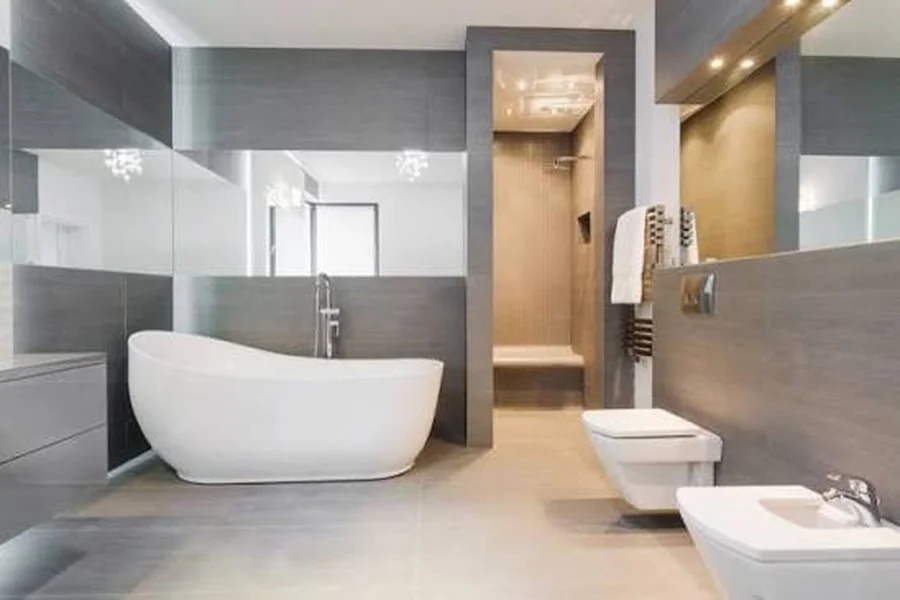
- Layer three, accent: Does the room have at least one element of visual interest created by light itself? A backlit mirror, a small pendant over a freestanding tub, or an under-cabinet strip at the toe kick all qualify. This layer is optional in a budget bathroom, but it’s non-negotiable if you’re targeting buyers in the luxury segment.
A room that passes all three layers reads as intentional. One that fails even one layer reads as incomplete, regardless of how much money went into the tile or the hardware.
LED Efficiency Is No Longer a “Nice to Have”
Beyond aesthetics, buyers are increasingly scrutinizing operating costs. LED fixtures have moved from trend to table stakes. The U.S. Department of Energy’s SSL Forecast Report projects that by 2035, LED lamps and luminaires will comprise 84% of all lighting installations, reflecting a market shift that’s already well underway in residential renovation. Buyers touring homes in 2026 recognize the visual and tactile difference between an LED fixture and a legacy incandescent setup, and they’re factoring running costs into their mental ledger.
Dimmable LED fixtures are worth the slight price premium. A bathroom that can shift from bright morning task light to soft evening ambient light serves daily life better, and it demonstrates a level of polish that shows up in how buyers describe the space afterward. “It felt spa-like” is the review you want. That feeling is almost always a function of controllable light, not expensive stone.
Fixture Types and Where They Belong
| Fixture Type | Best Position | Primary Function | Common Mistake
|
|---|---|---|---|
| Vanity bar | Above mirror | Task lighting | Mounted too high, creating downward shadows |
| Wall sconces | Flanking mirror at eye level | Shadow-free task light | Placed too far apart from the mirror |
| Flush-mount ceiling | Center of room | Ambient fill | Used as the only light source |
| Recessed downlights | Perimeter, not over mirror | Ambient and accent | Directly above the vanity user |
| Pendant or chandelier | Above freestanding tub | Accent and statement | Installed in rooms with low ceilings |
| Backlit mirror | Over or surrounding mirror | Task and accent | Wrong color temperature for the room’s tone |
Making the Right Call Before You Buy
Here’s where most homeowners lose money: they choose fixtures based on how they look in a showroom under the showroom’s own lighting, without thinking through how those fixtures will perform in their specific bathroom geometry. A pendant that looks stunning at eight feet of ceiling height becomes a head-hazard at seven feet. A brushed nickel finish that reads as warm in the store reads as cold under the natural light coming through a north-facing window.
The fix is simple but takes deliberate effort. Bring your bathroom’s dimensions, ceiling height, and a photo of your mirror to any fixture consultation. If you’re in Southwest Florida and sourcing for a renovation project, browsing luxury bathroom lights in Bonita Springs through a local showroom gives you the advantage of seeing actual scale and getting input from staff who know the region’s architectural preferences, which run warm, coastal, and layered rather than stark and minimal.
Run your plan through the Three-Layer Test before finalizing anything. If you can’t check all three boxes, add a fixture or swap one out before the renovation is done. Retrofitting lighting after a bathroom is finished costs two to three times as much as getting it right the first time.
The Upgrade That Pays You Back
Bathroom lighting is one of those upgrades that feels cosmetic but operates as something deeper. It shapes how buyers feel in the room before they’ve consciously evaluated a single feature. It affects how your listing photographs. It determines whether a space reads as move-in ready or as a project.
You don’t have to renovate the whole bathroom to get there. Sometimes a pair of sconces flanking the mirror and a dimmable LED flush mount overhead is the entire investment. The question worth sitting with is this: if a buyer walks into your bathroom tomorrow, what does the light tell them about how you’ve cared for your home?