Two collars end up in the same few centimetres of space, and that’s really the whole problem in one sentence. A hooded sweatshirt was never drawn up with a shirt underneath it, so the hood wants to sit exactly where a collar already is, and one of them has to lose. Pulling an Essentials Hoodie over an Oxford shirt does work, and it works more often than the internet suggests, but only once you’ve decided which collar is doing the talking and which one is quietly along for the ride.
Why a hood and a collar argue
Part of it is just that a hood carries more fabric than people give it credit for, being a cowl rather than a flat panel, and it comes to rest across the top of your shoulders with a bit of weight behind it while the shirt collar underneath is still trying to do its own job — standing up around the neck, folding back on itself, staying put. They’re both after the same three or four centimetres, give or take, so when the hood gets there first you end up with a collar that’s half squashed flat and half peeking out, which is the look that makes the whole outfit seem like something that happened to you rather than something you chose.
Collars that survive underneath
Button-down collars are the quiet winners here, and it’s not complicated — the little buttons hold the points flat against the shirt, so they can’t flap out sideways from under the hood halfway through the afternoon. An Oxford-cloth button-down in white or pale blue sits under almost anything without complaining.
Band collars (grandad collars, if that’s the name you grew up with) are the other clean answer, because there are no points to misbehave in the first place. You get a neat strip of shirt showing above the ribbed neckline and nothing else, which looks considered without anyone being able to say why.
Spread collars are the difficult one
A broad spread collar has long blades reaching out toward the shoulder seam, which is precisely where the hood lands, so the two end up overlapping in a way that’s hard to tidy. You can rescue it — tucking the points fully under and letting only the collar band show is one route — but you’re working against the shirt rather than with it, and on a cold morning you won’t bother.
The hoodie’s own neckline matters just as much
Here’s the bit people skip. Essentials pieces run with an oversized cut, so the ribbed crew neckline tends to sit a little lower and wider than it would on a slim-fit sweatshirt, whether the body is French terry or something heavier, and that extra room is doing you a favour. There’s somewhere for the shirt collar to actually be. A tight, high ribbed neck is the opposite — it grips the base of your throat and eats the collar whole, and no amount of adjusting fixes a neckline that’s physically in the way.
Sleeves, and the centimetre that gives you away
Cuffs are where most of these outfits fall apart, and it happens below the point where anybody is looking. A ribbed hoodie cuff gathers, a shirt cuff doesn’t, so one of them has to be in front and the decision needs to be visible rather than accidental.
- A centimetre or two of shirt cuff showing past the ribbed cuff reads as a choice someone made.
- Nothing showing at all is also fine, as long as the collar is clearly doing its job up top.
- Four or five centimetres of loose cuff hanging out is the version that looks like you got dressed in a hurry.
- Sleeves pushed up to mid-forearm sidestep the question completely, which is why half the people you see have done it.
Colour, and keeping the volume down
The colourways this line tends to come in lean muted — greys, taupes, blacks, creams, soft browns — and Fear of God’s diffusion line has never been especially loud about colour, which is genuinely helpful here, because a quiet sweatshirt over a quiet shirt doesn’t ask the viewer to resolve anything. White shirt under grey fleece. Pale blue under cream. Boring on paper, and it photographs well, which tells you something about how little work the combination actually needs.
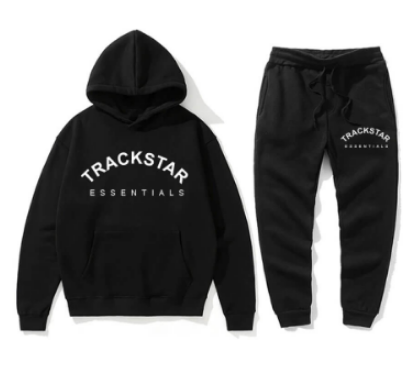
An Essentials Tracksuit top over a collared shirt is the harder version of this same question, since the matching bottoms already read as one planned outfit and a shirt collar arriving on top can tip it into fancy dress. Those sets run roughly C$165 to C$189 across the twenty or so in the category, and most people wear the top with the bottoms rather than breaking it up, which is probably the honest answer.
Where it stops working
A stiff, fused formal collar under fleece looks wrong and there’s no styling your way out of it. The shirt holds a shape that the sweatshirt then flattens, so you end up with an expensive collar doing a bad impression of a cheap one.
And there’s a Canadian wrinkle. Once it’s minus fifteen in Calgary or Montreal and you’ve happily got a toque on, the hood comes up over it, the shirt collar is under all of that, and nobody can see any of your careful work anyway. Shoulder season is when this outfit actually earns its keep — those April and October weeks when it’s eight degrees in the morning and sixteen by two in the afternoon.
Frequently Asked Questions
Should the shirt be tucked in?
Usually not, or at least not fully, because an oversized sweatshirt hem sitting over a tucked shirt creates a strange empty block around your middle. A shirt that’s slightly shorter than the hoodie and left out works better. If the shirt is long enough to hang well below the hem it starts looking like two separate ideas.
Does this work with a zip-up instead?
Better, I’d say, and mostly for a dull mechanical reason — an open zip leaves the shirt collar a clear V of space to settle into instead of asking it to come up through a closed neckline, and you can shift how much shirt shows just by moving the zipper a few centimetres either way.
What about a T-shirt collar showing instead?
Fine, and almost invisible, which is the point. A crew-neck tee under an Essentials Hoodie shows as a thin line of contrast at the neckline and reads as layering rather than as a shirt. It’s the low-effort option when a collared shirt feels like too much for the day.
None of this needs measuring or planning in the morning. A soft collar, a sweatshirt with enough room in the neck, a decision about cuffs, and the outfit holds together without looking like you threw it together. Have a look through the hoodies and tracksuits on the site and see which necklines leave the most room — that’s the detail that decides whether this works for you.