
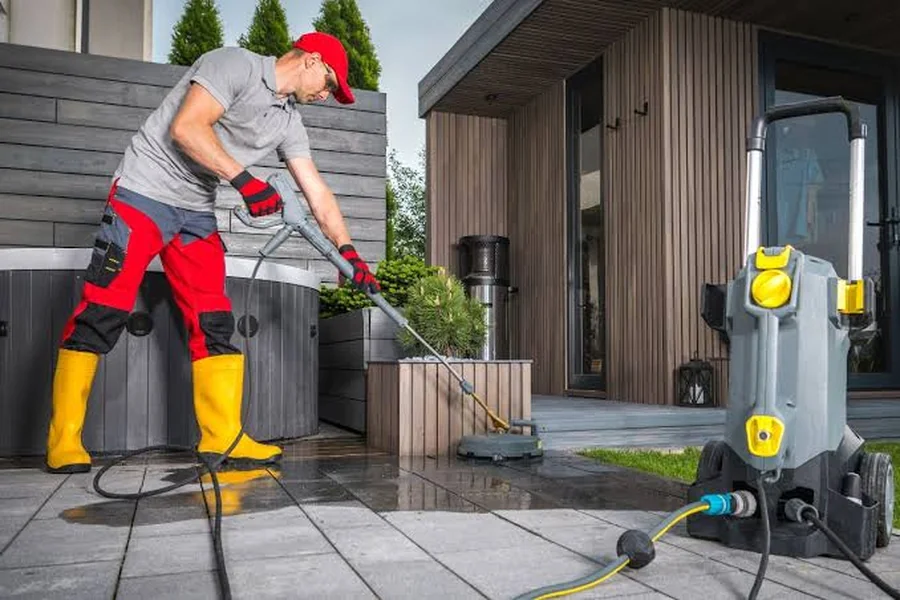
A pressure washer can remove years of grime from a concrete walkway in minutes, yet the same spray can damage a softer surface when used too aggressively. One of the most overlooked variables is not the machine’s rated PSI or the color of the nozzle it’s working distance. With pressure washers, moving the nozzle only a few inches can noticeably change the concentration and impact of the water stream.
Experienced operators learn to treat nozzle distance as a control mechanism. Rather than automatically working as close as possible, they adjust distance according to the surface, soil, nozzle, and cleaning objective.
Why Nozzle Distance Has Such a Significant Effect on Cleaning Power
The water leaving a pressure washer nozzle is concentrated into a relatively narrow stream. As that stream travels toward the surface, it spreads and becomes less concentrated.
That means a nozzle held close to a surface delivers a more concentrated impact over a smaller area. Moving it farther away reduces the intensity at any individual point while increasing the area being covered.
This creates a useful tradeoff:
- Closer distance: greater cleaning intensity and smaller coverage area
- Moderate distance: balanced cleaning power and coverage
- Greater distance: broader coverage with less concentrated impact
The practical lesson is simple: pressure is not the only variable determining cleaning performance. The distance between the nozzle and the material changes how that pressure is applied.
Start Farther Away and Move Closer Only When Necessary
A common mistake is beginning every job with the nozzle extremely close to the surface. That approach may remove stubborn dirt quickly, but it also gives the operator less margin for error.
A better technique is to begin at a conservative distance and make a test pass. If the soil remains, gradually move closer while watching the surface.
This approach is particularly useful when cleaning unfamiliar materials. A few extra seconds of testing can prevent permanent marks, chipped coatings, or damaged finishes.
For many household cleaning tasks, the manufacturer’s operating instructions should remain the primary reference because recommended distances can vary with equipment and accessories.
How Different Nozzle Types Change the Ideal Working Distance
Nozzle distance cannot be separated from nozzle selection. Different spray patterns distribute the washer’s output differently.
Narrow spray patterns require more caution
A narrow-angle nozzle concentrates water into a smaller area. When combined with a short working distance, the cleaning action can become extremely aggressive.
These configurations may be useful for durable surfaces and localized buildup, but they require controlled movement. Holding the stream stationary can create a visible difference between the cleaned and uncleaned portions of a surface.
Wider spray patterns cover more area
A wider spray pattern spreads the water over a larger section. This generally makes it easier to clean broad surfaces consistently, especially when the objective is removing loose dirt rather than attacking a deeply embedded stain.
Wider patterns can also make it easier to maintain an even pace across patios, driveways, siding, and other large areas.
Surface Material Should Determine Your Starting Distance
There is no universal nozzle distance that works for every cleaning project. The correct starting point depends heavily on the material.
Concrete and other hard masonry: These surfaces can generally tolerate more aggressive cleaning than painted or delicate materials, but joints, cracks, decorative finishes, and deteriorated areas still deserve caution.
Wood: Wood fibers can be damaged by excessive pressure or an overly close spray. Start farther away and use controlled passes that follow the grain where appropriate.
Painted surfaces: A concentrated stream can remove or disturb paint, particularly where the coating is already deteriorated. Maintain a greater distance and evaluate the finish continuously.
Vinyl siding: Excessive pressure or an unfavorable spray angle can force water behind siding panels. A broader spray and appropriate distance generally provide better control.
Vehicles and outdoor equipment: Finishes, decals, seals, and sensitive components require a more conservative approach than concrete. Distance becomes especially important around trim and vulnerable areas.
The material should always dictate the cleaning strategy—not the other way around.
A Simple Distance-Test Method for Better Results
When you’re unsure how aggressively to clean a surface, use a repeatable test instead of guessing.
Follow these four steps before tackling the entire area
- Choose an inconspicuous test spot.
Pick a section that will not be obvious if the finish changes. - Begin farther away than your intended working distance.
Make a short pass with the selected nozzle and spray pattern. - Move closer in small increments.
Stop as soon as the dirt is being removed effectively. There is rarely a benefit to using substantially more force than necessary. - Check the surface after drying.
Some damage or discoloration becomes easier to recognize once the water has evaporated.
This method turns nozzle distance into an adjustable setting rather than a guess.
Why Constant Motion Matters More Than Many Operators Realize
Even an appropriate distance can produce poor results if the nozzle remains stationary.
Water concentrated on one point for too long can create an uneven cleaning pattern or damage a vulnerable surface. Keep the wand moving at a controlled pace, overlapping passes slightly so that the finished area has a consistent appearance.
For large surfaces, work in manageable sections. Instead of randomly sweeping the wand back and forth, establish parallel passes and maintain approximately the same distance throughout each section.
Consistency is often more important than maximum cleaning force.
Match Distance to the Cleaning Problem, Not Just the Surface
Two areas made from the same material may require different approaches.
For example, consider a concrete driveway with light dust across most of its surface and a concentrated oil or mud stain near the garage. A broad, moderate-distance pass may be appropriate for general cleaning, while the stubborn spot may require a different nozzle, cleaning solution, slower movement, or carefully reduced working distance.
This is an important distinction: distance should be adjusted according to the combination of material and contamination.
Trying to clean an entire surface with the same aggressive setting can waste water and time while increasing the possibility of surface damage.
Common Pressure Washer Distance Mistakes to Avoid
Several habits repeatedly lead to inconsistent results.
Holding the nozzle too close
Getting closer feels like the obvious solution when dirt refuses to move. But excessive concentration can damage coatings and softer materials before the operator realizes what is happening.
Standing too far away for stubborn buildup
The opposite problem is also common. If the spray is too dispersed, the operator may spend significantly more time on each section without achieving adequate cleaning.
Moving at inconsistent speeds
A nozzle that moves rapidly over one section and slowly over another can produce obvious differences in appearance.
Ignoring the spray angle
Distance and angle work together. Spraying directly into vulnerable joints, seams, vents, or openings can create problems even when the distance itself seems reasonable.
Assuming PSI tells the whole story
A machine’s PSI rating does not describe exactly how much cleaning force reaches a particular surface. Nozzle design, flow rate, spray pattern, distance, and movement all influence the practical result.
A Practical Decision Guide for Working Distance
When deciding where to start, use this sequence:
- Is the material delicate or coated? Start farther away.
- Is the surface durable masonry? A closer working distance may be appropriate after testing.
- Is the contamination loose? Use a broader pattern and moderate distance.
- Is the buildup stubborn? Adjust cleaning method before simply increasing pressure.
- Is the surface showing damage or discoloration? Immediately increase distance or stop and reassess.
- Are you cleaning near seams, openings, or electrical components? Increase control and follow the equipment and surface manufacturer’s guidance.
This simple decision process is more reliable than choosing a distance based solely on what worked on the previous job.
Safety Should Remain Part of the Distance Equation
High-pressure water can cause serious injuries, and the spray can propel debris toward nearby people. The CDC recommends following the pressure washer manufacturer’s safety instructions and notes that high-pressure spray can cause serious wounds. (CDC)
OSHA likewise identifies high-pressure water streams and uncontrolled hoses as hazards and recommends appropriate protective equipment and inspection of hoses and connections before use. (OSHA)
For gasoline-powered equipment, location matters as much as nozzle distance. CDC guidance warns against operating gasoline-powered pressure washers inside homes, garages, or other enclosed or partially enclosed spaces because of carbon monoxide exposure. (CDC)
FAQ About Pressure Washer Nozzle Distance
How far should a pressure washer nozzle be from the surface?
There is no single distance suitable for every job. Begin farther away, test the surface, and gradually move closer until the desired cleaning effect is achieved without damaging the material.
Does moving a pressure washer nozzle closer increase cleaning power?
Generally, yes. A closer nozzle concentrates the spray over a smaller area, increasing the intensity delivered to that point. However, greater intensity is not always better because it can damage some surfaces.
Should you use the same distance for every nozzle?
No. Spray angle and nozzle design affect how water is distributed. A narrow spray generally requires more careful distance control than a wide spray.
Why does my surface look uneven after pressure washing?
Uneven results can come from inconsistent nozzle distance, walking speed, spray angle, overlapping passes, or changes in pressure and water flow. Maintaining a consistent technique helps produce a more uniform finish.
Can pressure washing damage concrete?
Yes. Although concrete is generally more durable than many household surfaces, excessive pressure, an overly concentrated spray, prolonged exposure, or existing deterioration can cause surface damage. Test an inconspicuous area first.
The Most Useful Pressure Washer Adjustment May Be the One You Make With Your Feet
Effective pressure washing is less about finding one perfect setting and more about learning how variables interact. Nozzle type, spray angle, pressure, flow, movement speed, cleaning solution, and working distance all influence the final result.
Among those variables, distance is particularly useful because it can be changed instantly without replacing the machine. When a surface needs more cleaning power, moving closer may help. When the spray becomes too aggressive, stepping back can immediately reduce its concentration.
That small adjustment can be the difference between simply removing dirt and cleaning a surface with precision.