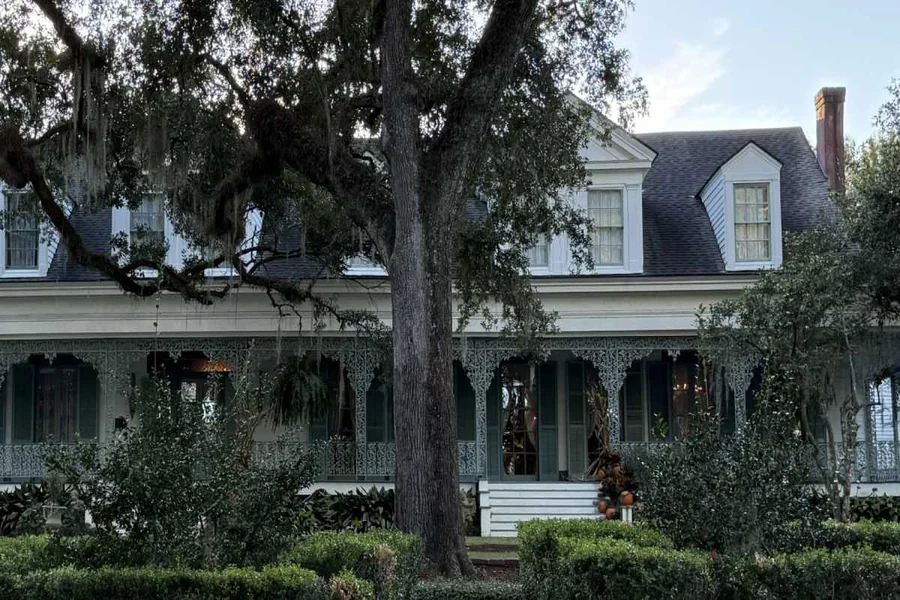
Twenty two minutes into the first ghost tour I ever took, nobody screamed and nobody saw a ghost. What got the whole group was a smell. Old pipe tobacco, suddenly, in a room where nobody smokes, on a night with no wind. The guide kept walking. I did not. That moment taught me more about haunted houses than any documentary ever has.
So here is the promise: I’ll show you why old buildings carry more atmosphere in one staircase than a whole night of jump scares, where that feeling actually comes from, and how to walk into a historic house and read it yourself. The short version is that ghosts are rarely the point. The building is doing the haunting, and it has been for a hundred years. It’s the reason historic ghost tours in Miami stay sold out while most scripted haunted houses fold after a season or two. A house that survived a hurricane, a fire, and four different families has already scared people for real. You’re just late to it.
I’m not a believer, for the record. But I’ll take a creaking 1920s staircase over a fog machine every single time.
What makes a house haunted?
Scientists have an answer, and it’s a better story than the ghost one. Low frequency sound, the kind you can’t consciously hear but feel in your chest, has been documented to cause chills, anxiety, and the sensation of a presence in the room. Old buildings hum with it. Window frames rattle. Plumbing kicks on at odd hours. Furnace ducts groan.
Add the rest of the package. Damp plaster holds smells. Unsealed wood breathes with the weather. In a place like South Florida, that range of temperature and humidity makes a building feel alive in a way a sealed modern condo never does. Your eyesight also drops in rooms lit by oil lamps or a single candle. Your brain fills every shadow with a body.
The result is a physiological prank you walk into voluntarily. And you know what? That’s still delightful, because your body reacts before your brain can argue.
The architecture of a scare
Look at the layout of any historic estate and you’ll spot the same pattern. Rooms connect to rooms. Staircases land where you don’t expect them. A former service wing, a root cellar, a sealed attic, a porch that wraps all the way around. Every one of those spaces is a hallway for your imagination.
Modern homes are maps. You know exactly where everything is. Old homes are mazes with a memory. Servants’ passages sit right next to formal parlors, which means a single tour route moves through three different social worlds in ten minutes. If you have ever walked a historic house at dusk and felt something follow you, it’s this. It’s the building telling you where people used to be.
Gothic fiction borrowed the same trick. You can trace the whole haunted house tradition through the Library of Congress and watch decades of American writers hand the pen to a building and let it speak. Poe, Jackson, and everyone in between figured out what a night tour proves in person: setting does the work. The ghost is the excuse.
Restoration is a ghost story you can read
Here’s a detail I picked up from a docent, and it changed how I look at old buildings forever. Layers.
When you strip wallpaper from a historic house, you don’t find one color. You find eight, each one a different decade, each one a different family’s taste. You find a patch where a wall outlet was. You find a door outline under a rug, meaning there used to be a passage on that wall and somebody closed it off. The building has been edited like a manuscript.
National Park Service preservation work rests on this same principle, that a structure’s physical fabric is itself a record you can research. If you want the professional version of what a ghost tour does by candlelight, that’s it. Restoration teams spend years turning those layers back into meaning. My favorite part of any old house is the beam that got scorched in a fire that nobody wrote down. It tells you something happened, and it refuses to tell you what.
That scorch mark is honestly scarier than most recorded ghost stories I’ve heard. It’s a real clue with a missing file.
How to read a haunted house in five steps
Take this with you on your next tour. It works whether the guide believes or not.
- Check the light first. Where do the shadows land at eye level? Guides don’t control that. Architects do, and they had no idea they were building a haunted house.
- Find the servants’ route. Kitchens, back stairs, and hidden corridors tell you who lived there and who was meant to stay invisible.
- Smell the rooms. Cedar, tobacco, mildew, and old varnish are part of the architecture. Your nose works on a delay, and that delay is where the eerie part lives.
- Look for edited walls. Outlet patches, painted over doorframes, and trim that stops short all mean the building changed shape and kept the receipt.
- Ask the guide what the house does at night. Pressure, temperature, noises, and light angles after dark are the best material a great tour guide will ever have.
None of that is spooky on paper. All of it is spooky in a dark hallway when you already know the house’s history.
The stories hold up because the details do
Craft is what separates a haunting that sticks with you from one you forget by the parking lot. Broad, anonymous claims land flat. Specific, ordinary details land hard. A guide who tells you the family kept a diary that went quiet for three months will get you. A guide who says “this room is very haunted” won’t.
That’s true of written accounts too. Many of the country’s oldest houses eventually reach the Smithsonian Institution, which is a different subject on paper but the same instinct underneath. Places and objects earn protection because people keep telling their stories. The patina, the provenance, the odd scrap of documentation, all of it functions like evidence. It also means ghost stories tend to improve for exactly the reason museum labels do. Someone cared enough to write it down.
Bring your skepticism. It’s more fun that way.
I’ll admit my bias. The nights I have felt the most in a historic house were the nights I knew the most about it. Not the nights I believed the most. Knowledge did the scaring, and it never once asked me to say a word about spirits.
So try this the next time you drive past a gray, peeling mansion on your commute. Find out who built it. Find out what it was before that. Then walk the grounds and see whether your own body starts filling in the blank.
If that itch gets under your skin, book the night version. Reservations exist because people keep showing up, and because the houses keep working. You’ll find the full details on the estate’s site and you can reserve your spot on its events page. Go. Flinch. Then tell me whether the staircase got you or the tobacco did.