
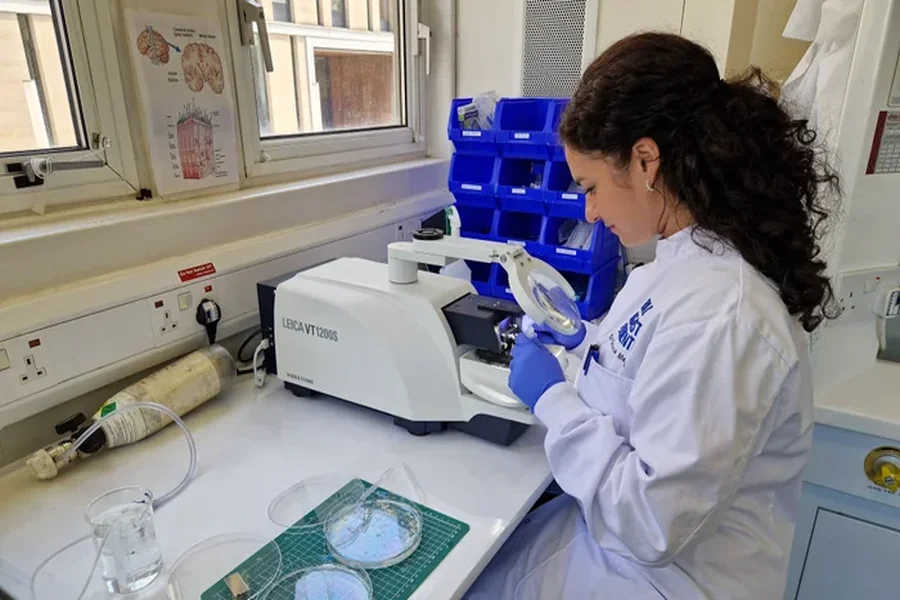
A frozen vial arrives at your bench, the label says frontal cortex, and you already know you are going to lose two weeks figuring out whether the donor history matches your cohort. That is the part nobody puts on the order page. A brain tissue sample is not a commodity the way a reagent bottle is. Two samples can carry the same anatomical label and still behave nothing alike in an assay, because what actually matters lives in the paperwork, not on the tube.
I have watched labs burn a grant quarter on specimens that turned out to be unusable for their specific question. The fix is almost never better lab technique. It is asking sharper questions before you order from a qualified supplier such as brain tissue sample vendors that document provenance. I wrote this so you can look at a spec sheet and know in five minutes whether a specimen fits your study, or whether it belongs in someone else’s freezer.
What are the four things that actually decide usability?
Most researchers obsess over anatomical site, and that is the easy part. You can look at a brain atlas and pick your region of interest in an afternoon. The harder questions are the ones you have to ask a vendor directly.
- Preservation method. Formalin-fixed paraffin-embedded blocks suit histology and immunohistochemistry. Snap-frozen tissue suits RNA and protein work, but only if the cold chain held.
- Donor history. Age, sex, ethnicity, and any disease state recorded at procurement. You need this to match your control and case groups without skewing them.
- Pathology annotation. Histologic grade, tumor type when applicable, and staging. Without these, a malignant specimen is just a label you have to trust.
- Chain of custody. Who handled it, when, and under what conditions. This is the one people forget to ask about until a reviewer does.
If a vendor cannot answer all four in writing, keep looking. My honest take: annotation quality is worth more than a lower price per milligram, every single time.
Why FFPE still carries most brain tissue research
Formalin fixation followed by paraffin embedding has been the workhorse of pathology for the better part of a century, and that institutional habit is exactly why the archive is so deep.
Hospitals fix and embed as standard practice, so retrospective collections run into the millions of blocks worldwide. Research slides and anonymized data drawn from those blocks count as human subjects research and fall under the federal human subjects framework, which the Department of Health and Human Services lays out through what is commonly called the Common Rule. You should know where your specimens sit relative to it before you write a protocol, not after.
The trade-off is real. Formalin cross-links proteins and fragments long RNA, so an FFPE block will not give you a clean transcriptome the way a frozen aliquot will. For morphology, tissue architecture, and most protein staining, it is still the better choice, and it is far easier to ship and store at room temperature. I would pick FFPE for anything structural and frozen for anything molecular. That split holds for brain work more reliably than for almost any other tissue, because neural architecture is the whole point of half the studies being run.
Normal, diseased, or tumor: matching specimen type to your question
Biobanks generally offer three categories, and mixing them up is the most common ordering mistake I see.
| Specimen type | Best used for | What to verify
|
|---|---|---|
| Normal brain tissue | Controls, baseline expression, method development | Donor age and region match your case set |
| Disease-positive tissue | Neurodegenerative and other disease-state comparisons | Documented diagnosis and staging criteria |
| Tumor specimens | Oncology targets, grade-dependent behavior | Tumor type, grade, and donor treatment history |
Here is where I would push back on how most labs order. They buy a small pilot batch, run one assay, and either commit fully or abandon the vendor. A better sequence is to request IHC results and molecular expression data alongside the first order, when available, and compare those to your own staining before you scale up. That single step has saved more projects than any protocol tweak I can name.
Building a procurement checklist you can reuse
Write this down once and your future self will thank you.
- Define your readout first. If it is molecular, you need frozen or validated FFPE extraction. If it is structural, FFPE is fine.
- Request donor demographics in a structured format, not a PDF of free text.
- Ask for histologic grade and stage on every diseased or tumor specimen, in writing.
- Confirm the institutional review board or ethics documentation covering the source collections. The Centers for Medicare and Medicaid Services governs the clinical laboratory side of American specimen handling, so a compliant vendor will already have this paperwork in order.
- Order a pilot batch sized to your real assay, not to the minimum the vendor will sell.
- Log everything into your LIMS on arrival, including block identifiers and receipt condition.
Skip step four and you risk discovering a compliance gap during peer review, which is the worst possible time to find one.
What changes when you scale past a pilot
Single specimens are easy. Cohorts get ugly fast. Once you are ordering dozens of blocks, consistency between batches matters more than any individual specimen, because a shift in fixation time or storage age across batches can show up as a fake effect in your data. Ask your vendor how they control for that. A supplier that sources from many facilities has to normalize handling somehow, and if they cannot describe how, they are not a serious partner for a multi-year study.
Genetic and genomic data carry their own governance layer, which the National Institutes of Health manages through its data sharing policies and Genomic Data Sharing requirements. If your work involves sequencing donor material, plan for that review early. Budget for it in time, not just money.
My working rule after a decade of watching this go wrong: treat the spec sheet as a primary source document. Read it the way you would read a methods section you intend to cite. If it is vague, the specimen is vague.
The short version
Your brain tissue sample is only as good as the record behind it. Preservation method, donor history, pathology annotation, and chain of custody decide whether the specimen answers your question or quietly poisons your dataset. Match specimen type to readout, pilot before you commit, and demand the ethics and governance paperwork up front.
Next time you open a vendor catalog, pull the four questions from this piece and send them before you click order. What is on your current spec sheet that you still cannot explain?