By mid-afternoon, your neck feels tight. You move the monitor, sit taller and promise yourself you’ll stop slouching. Half an hour later, you’re back in the position that felt comfortable while you answered the last email.
It’s easy to call that “postural damage.” The phrase suggests your back has been bent into the wrong shape and needs to be put back. For most desk workers, that isn’t a helpful way to understand the problem. NHS guidance says there is no perfect posture and that a particular sitting position does not, by itself, cause low back pain. Holding any position for a long time can become uncomfortable, though, especially when work leaves little room for movement. NHS guidance on desk-based work recommends changing position regularly.
So what can a desk worker reasonably expect from a movement programme such as clinical Pilates? The answer has more to do with building options than enforcing one ideal way to sit.
A Slouch Is Not a Diagnosis
You can sit upright for a meeting, lean back to read or shift forward to type. None of those positions is automatically harmful. The problem may be that one task keeps you still for too long, or that discomfort has made you reluctant to move at all. A low monitor, an awkward reach for the mouse or a chair that doesn’t support your work can add to the irritation.
Start by noticing the pattern rather than judging your silhouette. Does the ache build after several uninterrupted hours? Does a short walk change it? Is the trouble confined to the workday, or does it affect sleep and other activities? Those details tell a clinician more than a photograph of you “sitting badly.”
An exercise plan also needs to account for the person behind the desk. Someone returning after an injury may tolerate different movements from someone who is generally active but feels stiff after long video calls. Neither needs to be told that their spine is fragile.
What Does Clinical Pilates Actually Train?
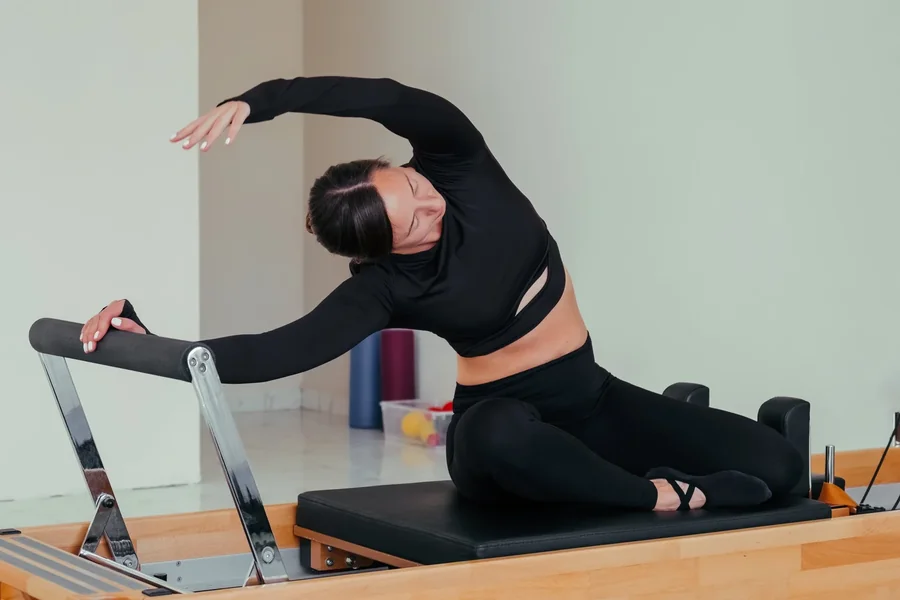
Pilates uses controlled movement, breathing and graded exercise. In a clinical setting, the exercises can be selected and adjusted in response to an assessment, symptoms and functional goals. That might mean beginning with an easier range of movement, changing the resistance or working on how the trunk and hips share a task. The aim is to practise movements a person can repeat and gradually make more demanding, not to hold a rigid “correct” posture all day.
For desk work, useful goals are concrete: turning your head comfortably between screens, getting up from a chair without guarding, or feeling capable of carrying a bag after work. Exercises involving the trunk, shoulders and hips may provide ways to build strength and coordination around those tasks. A programme should be reviewed against what changes in daily life, rather than how straight someone looks in a mirror.
Progression matters here. A movement that is manageable lying down may later be practised sitting, standing or with added resistance. The clinician can adjust the challenge if a position provokes symptoms or feels too easy. That progression gives a desk worker something more useful than repeated reminders to “engage your core”: a chance to practise control across the positions the day actually requires.
Clinical Pilates is an exercise option, not a unique fix for desk-related pain. In a randomized trial of adults with chronic low back pain, an individualized, physiotherapy-delivered clinical Pilates programme and a general exercise programme produced similar improvements. The study wasn’t a test of office workers or a promise about any one patient’s result. It does show why the fit of an exercise programme and the ability to keep doing it matter more than an impressive label.
What Happens Between Sessions Counts
An hour of exercise cannot make eight motionless working hours disappear. The workplace part of the plan may be less glamorous than Pilates: alternate tasks, stand for a call, walk for a few minutes or change position when you’ve been sitting for a while. Canada’s Centre for Occupational Health and Safety recommends interrupting computer work with tasks that let you move or change position.
You don’t need to sit perfectly in the intervals. Adjust the workstation so it feels workable, then give yourself permission to shift. A sit-stand desk can offer another position, but standing still all day isn’t the goal either. The useful feature is the chance to vary what your body is doing.
Small changes are easier to judge when you link them to a specific problem. If your neck becomes uncomfortable during back-to-back calls, try a change in screen position and a short movement break between calls. If the issue persists, that observation helps guide a more individual assessment. Guessing at a universal “desk posture” does not.
When Is a More Individual Plan Useful?
Persistent or worsening pain, symptoms that limit normal activity, or discomfort that doesn’t improve when you change your work pattern deserve an assessment. A clinician can help determine what may be contributing and whether exercise needs to be modified. New neurological symptoms or other concerning changes should be assessed promptly rather than treated as an ordinary consequence of sitting.
If you are considering Clinical Pilates, ask what the exercises are meant to help you do and how progress will be measured. Perhaps the goal is working through a morning with fewer interruptions, or returning to exercise outside the office. Those are more useful targets than trying to erase a “bad” posture. You need room to move, enough capacity for the work and a plan that can change as you do.