A desktop humidor is more than a handsome storage box. It is a small, controlled environment responsible for preserving the flavour, aroma, burn quality, and construction of every cigar inside it.
Choose poorly, and even well-made cigars can become dry, brittle, harsh, or overly damp. Choose well, and your collection will age gracefully, draw consistently, and be ready when the occasion calls for it.
The best desktop humidor is not necessarily the biggest or most decorative model. It is the one that fits your collection, maintains stable conditions, and makes routine care straightforward.
Start With the Conditions Cigars Actually Need
Most handmade cigars perform well at relative humidity levels between roughly 65% and 72%, with many enthusiasts settling around 65% to 69% for a slightly firmer draw and cleaner burn. Temperature matters, too. A room around 65°F to 70°F is generally comfortable territory.
Stability is more important than chasing a perfect number.
A humidor that swings repeatedly from 60% to 75% relative humidity can cause more problems than one holding steadily at 67%. Excessive moisture may lead to a tight draw, uneven burn, or the risk of mould. Too little humidity can dry the wrapper, make it crack, and strip away oils that carry much of a cigar’s character.
Before comparing finishes or capacities, ask a simpler question: can this humidor create a reliable seal and support a consistent humidity-management routine?
Choose Capacity Based on Your Real Habits
Humidor capacity is often described in terms of how many cigars it can hold, but those figures should be treated as estimates. They are usually based on one standard cigar size, often a robusto or corona. A collection made up of thick ring-gauge cigars, large toros, or boxed cigars will occupy significantly more space.
It is also wise not to fill a humidor to the brim. Air needs room to circulate, and a packed box makes it harder for humidity to distribute evenly.
Leave Room for Your Collection to Grow
Think about the number of cigars you usually keep on hand, then allow extra space for new purchases, gifts, or a handful of cigars you want to rest before smoking. For someone who keeps 15 to 25 cigars at a time, a 50-count desktop model may be more practical than a tightly packed 25-count box.
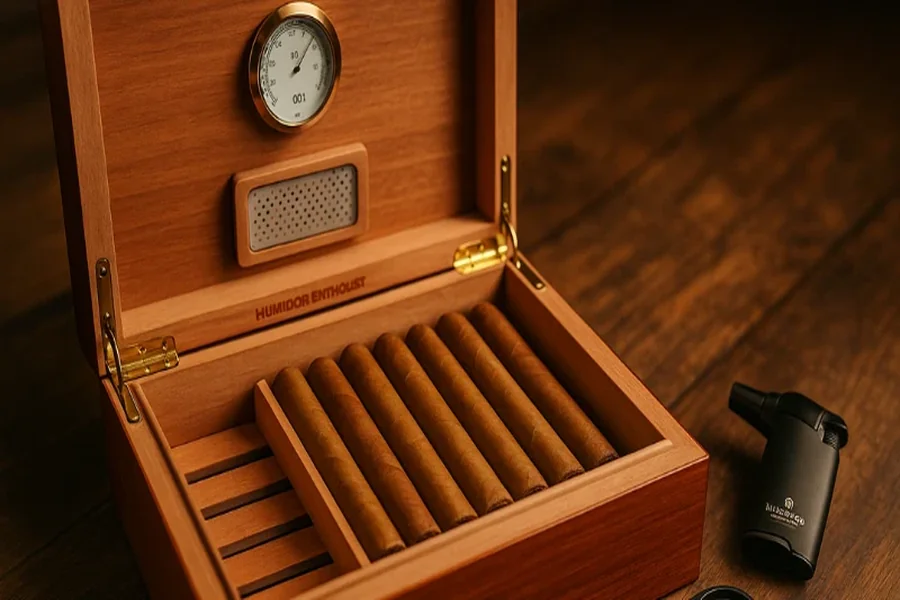
When comparing premium desktop humidors for cigar lovers, look beyond the advertised count and consider the internal layout. Dividers, removable trays, and sufficient depth can make a modest-sized humidor far more useful in daily life.
Pay Close Attention to Construction and the Seal
A humidor’s ability to hold humidity depends largely on its seal. Open and close the lid, if possible, and listen for a soft whoosh of air as it settles. This is often called the “humidor seal test,” though it is not a scientific guarantee on its own. It does, however, offer a useful first impression.
The lid should sit flush without wobbling, gaps, or excessive force. Hinges should feel solid, and the body should not flex when handled. A poorly fitted lid invites constant moisture loss, forcing your humidification system to work harder and making readings less predictable.
Wood construction also matters. Spanish cedar is the traditional interior material for good reason: it helps buffer humidity changes, has a pleasant natural aroma, and can discourage tobacco beetles. Do not confuse this with any cedar used on the exterior. What matters most is the lining inside the storage chamber.
A humidor does not have to be made entirely of solid Spanish cedar to work well. Many quality designs use a stable outer structure with a Spanish cedar interior, balancing appearance, durability, and humidity performance.
Select a Humidification Method You Will Maintain
No humidification system is entirely maintenance-free. The practical choice is the one you will check and refill consistently.
Traditional floral foam units are inexpensive but can be temperamental, especially if filled with untreated tap water. They may require frequent attention and can promote bacterial growth if neglected. Modern alternatives tend to be easier to manage.
Many desktop humidor owners prefer two-way humidity control packs. These release or absorb moisture as needed, making them especially useful for newer collectors or for humidors opened only occasionally. Gel jars, beads, and electronic humidifiers can also work well, although they differ in cost, upkeep, and precision.
Whichever method you choose, use distilled water when the system calls for water. Minerals in tap water can leave deposits and interfere with performance over time.
Do Not Overlook the Hygrometer
A humidor without a reliable hygrometer is guesswork. Many models include analogue hygrometers, and while they may suit the traditional appearance of a wooden humidor, they are not always the most accurate.
A calibrated digital hygrometer is often the more dependable option. Look for one that displays both relative humidity and temperature, since the two are closely connected. Place it where it can measure the internal environment rather than directly beside the humidification device.
Calibrate Before You Trust the Reading
Even a new hygrometer can be off by several percentage points. Calibrating it before use is a small task that can prevent months of unnecessary adjustments. Once calibrated, check it periodically, particularly when seasons change or when you notice cigars behaving differently.
If your reading changes sharply every time you open the lid, that is normal. Focus on the level it returns to after several hours or overnight.
Consider Placement and Everyday Use
A well-built humidor can still struggle if it sits in the wrong place. Avoid direct sunlight, radiators, air-conditioning vents, kitchens, and any area with large temperature swings. A stable shelf, desk, or cabinet in a temperature-controlled room is usually best.
Also consider how often you will open it. If you reach for a cigar every day, a desktop humidor with easy access and a straightforward organiser may be more useful than an elaborate display piece. If you smoke less frequently, a tighter seal and low-maintenance humidity packs may take priority.
Ultimately, the right desktop humidor should make good cigar care feel routine rather than technical. Choose a sensible capacity, insist on sound construction, use an accurate hygrometer, and keep humidity stable. Those fundamentals will do far more for your cigars than any decorative detail ever could.