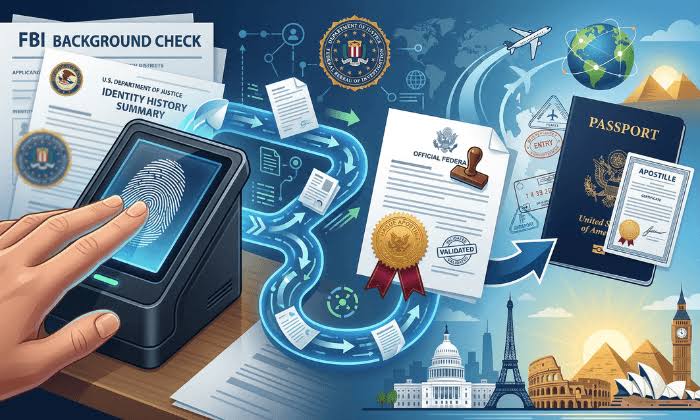
Getting an FBI background check ready for use abroad can involve two federal offices, each with its own processing queue. The FBI issues the Identity History Summary, which bears the watermark and signature of an FBI division official. The U.S. Department of State can then authenticate the official’s signature and issue an apostille for use abroad.
A start date may be agreed well before either queue has cleared, making an FBI background check apostille a scheduling problem as much as a paperwork one. This guide explains how to check the receiving authority’s requirements, obtain the report, arrange federal authentication, and plan around your relocation date.
Confirm What the Overseas Authority Requires
The receiving authority determines which requirements the background check must meet, while U.S. officials handle the report’s issuance and authentication. A report issued according to U.S. procedures may still be rejected abroad if it does not meet the destination authority’s specific requirements.
Required Background Check and Accepted Format
Authorities differ on which check they accept. A background check for overseas employment may need to be the federal FBI report, while some ministries accept a state or local police certificate, and others require both.
The two travel different routes. A federal record goes to the Department of State, while a state or local police document generally follows the authentication process of the state where it was issued. Ask the receiving authority to confirm its requirements in writing, including which agency must issue the background check and what form of authentication it requires.
Issue-Date Limits and Translation Instructions
Recency and language are set by the destination rather than by Washington. Ask how recently the report must have been issued and whether it needs to be accompanied by a translation.
The Office of Authentications requires the document to show a date of issuance. If the destination requires a translation, check whether it must be completed by a professional translator and notarized. The report itself does not need notarization for the federal apostille process.
Obtain the FBI Report Before Starting Authentication
The FBI Identity History Summary is the report in question. It is compiled from fingerprint submissions and contains information associated with arrests and, in some cases, federal service, naturalization, or military service.
Three routes are available, with different processing times:
- Electronically. Submit a request at edo.cjis.gov. You can have your fingerprints taken electronically at a participating U.S. Post Office or mail a completed fingerprint card to the FBI. Electronic results are typically processed faster.
- By post. Mail the completed application and fingerprint card to the FBI. Processing begins when the request and fingerprint card are received, and the $18 fee is the same as for an electronic request. Allow additional time for delivery in both directions.
- Through an approved Channeler. Each channeler sets its own turnaround time and fees. This option is available to U.S. citizens and lawful permanent residents in the United States and its territories.
Fingerprinting requires advance planning for applicants already abroad, since U.S. embassies and consulates do not provide this service for FBI background checks. Check the FBI’s current instructions for application requirements and fees.
Use the Federal Apostille Route
An FBI background check is a federal document, so the apostille is issued by the Office of Authentications at the U.S. Department of State. The application must include Form DS-4194, a $20 fee per document, and the name of the country where the document will be used.
Federal Documents and State Documents
The authentication route depends on the official who signed the record. Federal documents include those signed by a U.S. federal official, a U.S. consular officer, a foreign consul registered with the Department of State’s Office of Protocol, or a military notary or judge advocate. The FBI Identity History Summary falls into this category.
A federal apostille for the report must be obtained from the Office of Authentications at the U.S. Department of State. State-issued records follow a separate route: for use in a country covered by the Hague Apostille Convention, they must be apostilled by the competent authority in the state where they were issued.
Apostille and Non-Apostille Destinations
The type of authentication depends on the destination country. An apostille is used for countries that are parties to the Hague Apostille Convention; other destinations require an authentication certificate.
The second route involves an additional step. After the U.S. Department of State issues the authentication certificate, the document may need further legalization by the destination country’s embassy or consulate in the United States before it can be used abroad.
Build the Apostille Into Your Application Timeline
Work backward from the start date. Allow enough time for an apostille on the FBI background check, accounting for the FBI’s processing time and the separate queue at the U.S. Department of State.
These timelines help determine when to start:
- The report. The FBI does not guarantee a fixed turnaround; electronic results are typically processed faster than mailed requests.
- Authentication by post. Five weeks from the date the Office of Authentications receives the request. Although tracking may show delivery to Sterling, Virginia, the package takes several more days to reach the Washington, D.C., office for processing.
- Authentication in person. Seven business days. Walk-in drop-off is available Monday through Thursday, from 7:30 to 9:00 a.m., for applicants traveling in two to three weeks.
Same-day service falls outside the standard schedule and requires an appointment. Appointments are available Monday through Thursday, from 10:00 a.m. to 2:30 p.m., for applicants traveling abroad within two weeks because an immediate family member outside the United States has died, is dying, or has a life-threatening illness or injury. Applicants must provide proof of travel and documentation of the emergency in advance.
Most moving abroad documents can be processed concurrently, so submit the FBI report request early while arranging the degree and any other required paperwork.
Check the Completed Application Package
A package may be returned if key requirements are missed. Check the following before mailing it:
- Form DS-4194, completed with the country where the document will be used.
- The $20 fee per document, paid by check or money order for mail-in requests.
- A legible date of issuance on the FBI report.
- A professional translation with notarization, if required by the destination country.
- The original report, left un-notarized, with the official’s signature, printed name, title, and agency seal clearly legible.
The authenticated report and its apostille are the documents an employer or ministry abroad will review. Check the returned package before forwarding it, as resolving a missing certificate can delay your plans.